Our Blog
What Jumping Out of a Plane Taught Us About Learning
Our Blog

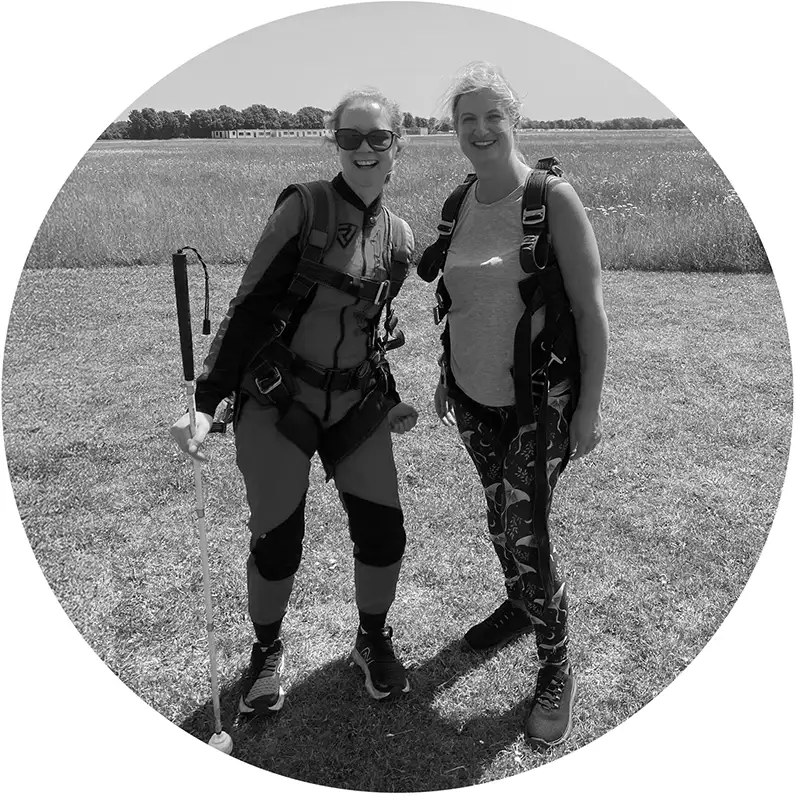
Yet there we were.
Loren and I had both signed up for a skydive, but what fascinated us afterwards wasn’t the jump itself. It was how differently we experienced it.
For Loren, this wasn’t her first skydive. Once out of the aircraft, she fully embraced the experience: flips, somersaults, and steering the parachute into tricks on the descent.
Meanwhile, I took a rather different approach.
As a first-time skydiver, I found myself wondering how my nervous system would respond to the experience. Rather than seeking more intensity, I opted for slow and steady.
From the outside, it may have looked as though we were having entirely different experiences.
In reality, we were both engaging with the same challenge in ways that suited who we are.
That got us thinking about counselling training.
People often arrive at training believing there is a “right” way to learn, participate, reflect, or develop.
There isn’t.
Some people process by talking things through immediately. Others need time and space.
Some enjoy stepping into new experiences quickly. Others prefer to move more cautiously and thoughtfully.
Some people thrive through action. Others through reflection.
Meaningful learning doesn’t come from everyone responding in the same way. It comes from understanding ourselves well enough to know what we need and being supported to develop from there.
At DATS, diversity isn’t simply about who is in the room. It is also about recognising the different ways people experience, process and engage with the world around them.
For me, there was another layer to the experience.
As someone with ADHD, I’ve often noticed that I can appear remarkably calm in situations that other people might experience as highly stressful. Novelty, urgency and intense focus can sometimes create a kind of clarity rather than overwhelm.
Standing at the open door of an aircraft at 13,000 feet probably should have been one of the most nerve-wracking moments of my life.
Instead, I felt surprisingly present.
The world became very simple.
There was only the experience directly in front of me, the rush of air, the view below, and the moment itself.
My instructor even commented on how calm I seemed.
What I’ve learned over the years, however, is that calm in the moment doesn’t necessarily mean my nervous system isn’t working hard behind the scenes.
In fact, the processing often comes later.
Sure enough, once I was safely back on the ground and the excitement had passed, my body seemed to decide it was finally time to acknowledge what had just happened.
What followed involved full-body shaking, questionable coordination, exhaustion, and requiring my partner to feed me pancakes as though I’d just returned from some heroic quest.
The skydive was exhilarating.
The hour afterwards was considerably less elegant.
It was also a useful reminder that there isn’t always a straightforward relationship between what we feel, what we show, and what our nervous systems are doing.
The way we respond to challenges is deeply individual. Neurodivergence adds another layer to that picture, highlighting that people may experience, process and recover from the same event in very different ways.
Counselling training can be a little like that too.
Sometimes the most significant learning doesn’t happen during a teaching session. It happens afterwards, when something begins to settle, make sense, or connect with our own experience.
Sometimes growth looks exciting and obvious.
Sometimes it arrives immediately.
Sometimes it appears later, when we least expect it.
At DATS, we believe diversity is about more than representation. It is about recognising that people bring different experiences, different strengths, different ways of learning, and different ways of being in the world.
Our role as trainers isn’t to make everyone approach things in the same way.
It’s to create a learning environment where those differences can be recognised, respected and worked with.
The skydive wasn’t intended as a metaphor when we booked it.
It was simply something we wanted to do.
But somewhere between stepping out of an aircraft and eating recovery pancakes, it became a surprisingly good reminder of the values we hope to bring to DATS.
Growth rarely looks identical from one person to the next.
And that’s exactly as it should be.
Although we should probably clarify one thing.
Skydiving is not currently part of the CPCAB Level 2 curriculum.
For now, we’ll stick with reflective practice, meaningful conversations, personal development, and considerably fewer parachutes.